Roofing Lead Generation: How Roofers Get Leads and Win the Job
Where roofing leads come from, real roofing ads to learn from, and the follow-up system that books the inspection before another roofer calls back.
 By Akash Mehra
13 min read
Table of contents
A hailstorm rolls through on Tuesday night. By Wednesday morning, every homeowner on the street is looking up at their roof.
They fill in two or three forms. Maybe four. The first roofer to call books the inspection. The others get a polite “we already have someone coming out.”
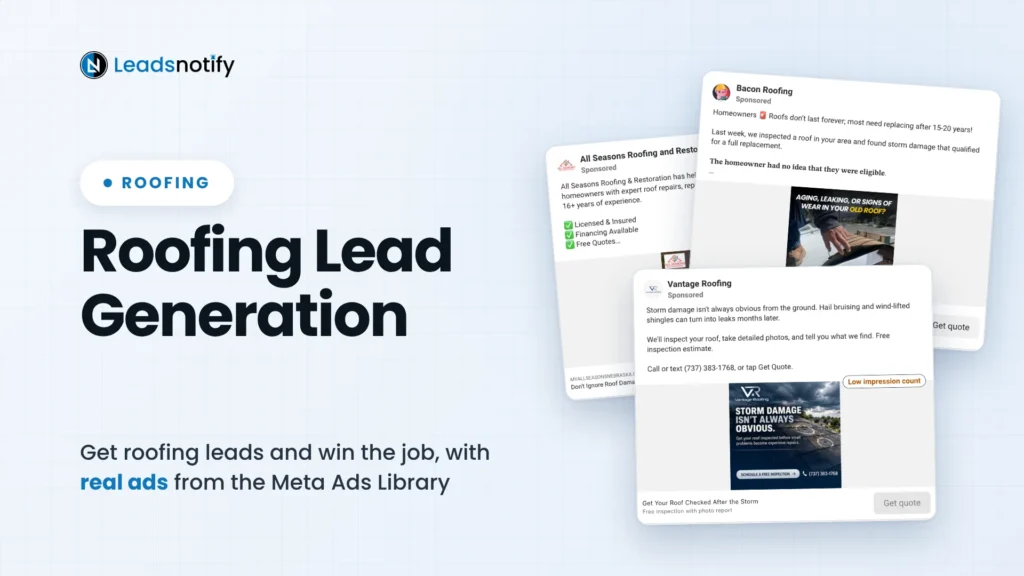
Roofing lead generation has two halves: getting the form filled in, and being the first to call. Most roofers spend all their money on the first half and lose the job on the second. We went through the Meta Ads Library and pulled live roofing ads to show what is working right now, then the follow-up system that gets you on the roof first.

What counts as a roofing lead
A roofing lead is a homeowner (or property manager) who needs roof work and gave you a way to reach them. Name, phone and address at minimum. The address matters more in roofing than in most trades. It tells you the service area, the roof type from satellite, and whether the storm hit that street.
Roofing leads fall into four types, and each one needs a different speed:
- Storm and insurance leads: hail or wind damage, often with an insurance claim. Urgent. The homeowner is calling around today.
- Leak and repair leads: water in the ceiling. Urgent and small. Win it fast and you often win the replacement later.
- Replacement leads: an old roof, a planned project, quotes from three companies. Weeks, not hours. Still decided by who shows up first and looks most organised.
- Commercial leads: flat roofs, property managers, longer sales cycles. Fewer, bigger, slower.
The first two are a race. The second two are a process. Your follow-up should know which one it is dealing with, and your lead form can tell it.
Where roofing leads come from
1. Facebook and Instagram lead ads
The most controllable channel for most roofers. Meta lead ads open a short, pre-filled form inside Facebook or Instagram. A homeowner books a free inspection in two taps without leaving the app. Our guide to setting up Facebook instant forms walks through the form itself, and the same form runs on Instagram lead ads.
Why it suits roofing: you can turn it on the morning after a storm, aim it at the ZIP codes that got hit, and turn it off when the crews are booked. No other paid channel moves that fast.
The catch is where the leads land. Instant form leads sit in Meta’s Leads Center until you download them or connect a tool. Leads Center sends no instant alert for each new lead, and it is not in the Meta Business Suite mobile app. Meta also deletes instant form lead data after 90 days. A crew lead on a roof is not checking a desktop dashboard.
2. Google Local Services Ads and search
High intent. The homeowner typed “roofer near me” or “roof leak repair”. These leads usually cost more than social leads because the person is ready now. The same rule applies: whoever calls back first wins most of them.
3. Door knocking after storms
Still common, and it still works in hail country. The weak point is paperwork. A notebook of addresses from Saturday’s canvass is a list of warm leads that nobody follows up. Give canvassers a QR code to a short lead form. Every door knock lands in the same pipeline as your ad leads.
4. Referrals, yard signs and partners
Past customers, the neighbours who watched your crew work, real estate agents who need roofs certified before closing, and insurance agents. Referral leads convert best. They also need a system: a thank-you after the job, a yard sign for the week of the install, a check-in after the next big storm.
5. Bought roofing leads
Lead vendors sell roofing leads by the piece. Some of those leads are sold to several roofers at once, so you are paying to join a race. If you buy leads, speed is the only thing that makes them pay. If you generate your own with the channels above, the homeowner asked to hear from you, not from four companies.
Real roofing ads running right now
Before you build your own ads, spend ten minutes in the Meta Ads Library, the public archive of every ad running on Facebook and Instagram. Search “roof inspection” and your state. You will see which offers local roofers run and how long each ad has been live. An ad that has run for months is an ad that pays for itself.
Here is what we found on 12 October 2026. Every one of these was live in the US. Click any screenshot to see the ad in the Ads Library.
1. The roofer on camera
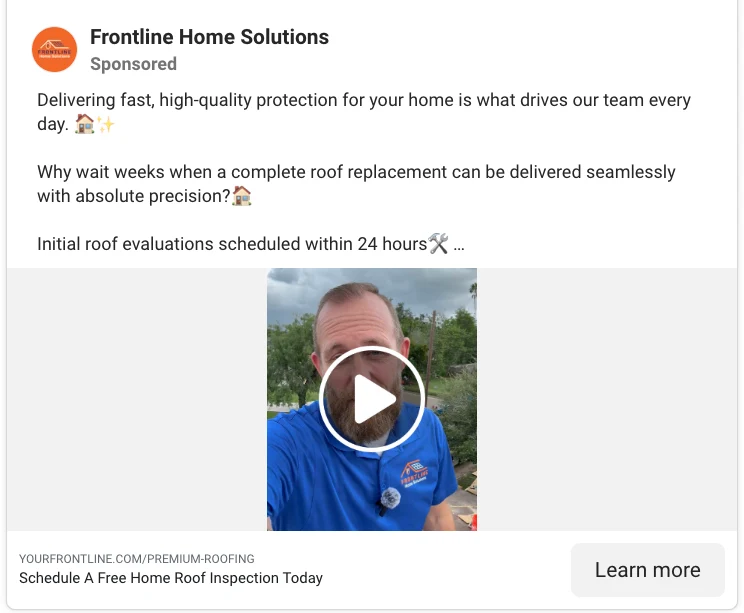
A home services company is running a phone-filmed video of a roofer talking straight to camera, with the promise that initial roof evaluations are scheduled within 24 hours. It runs the same free inspection offer under three headlines at once: Schedule A Free Home Roof Inspection Today, Get Your Free Professional Roof Inspection Today and Upgrade Your Roof With Free Expert Inspection. The lesson: keep the offer fixed and test the words. A real face beats a stock photo.
2. The storm timing ad
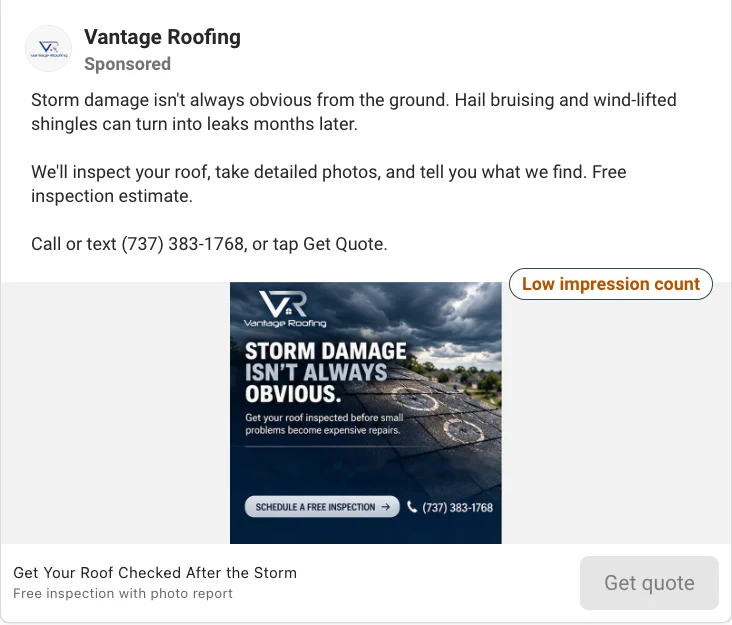
A roofing company started this one the day after storms rolled through. “Storm damage isn’t always obvious from the ground.” It promises an inspection with detailed photos, and the button says Get quote. It names the exact worry the homeowner already has, with no discount and no hard sell.
3. The story hook with a trust stack
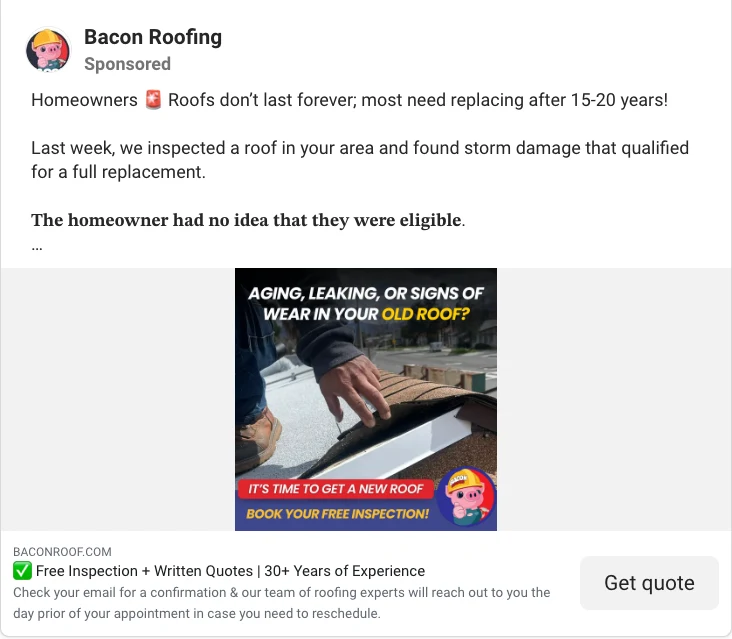
A roofer opens with a short story: last week they inspected a roof nearby and found storm damage that qualified for a full replacement, and “the homeowner had no idea they were eligible.” The headline stacks three reasons to pick them: Free Inspection + Written Quotes | 30+ Years of Experience. The small print even tells the homeowner what happens next. Homeowners worried about storm chasers read that as “this one is safe.”
4. The insurance angle
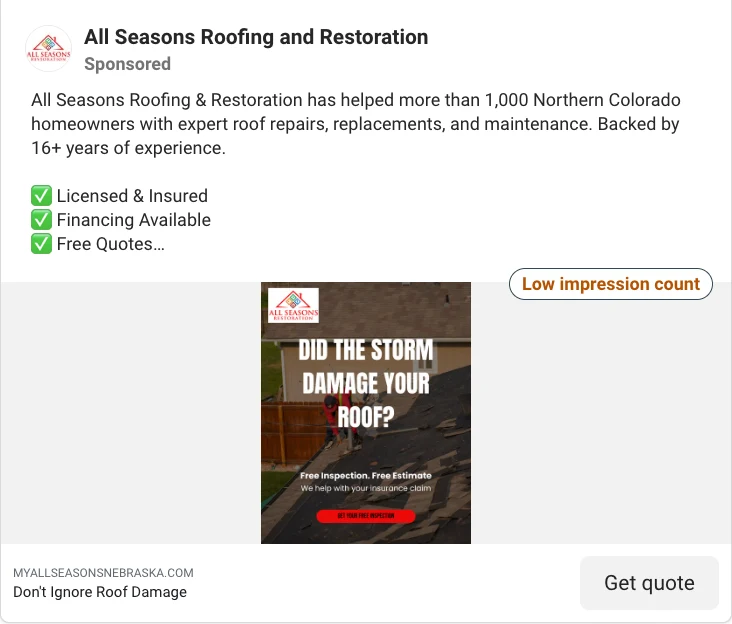
A restoration company asks one question in the image: “Did the storm damage your roof?” Then it answers the homeowner’s next two worries before they ask: free inspection, free estimate, and “we help with your insurance claim.” The body backs it with proof points: years in business, licensed and insured, free quotes.
5. The question homeowners ask after a storm
This one is from an insurance agency, not a roofer, but it shows the question in the homeowner’s head: “Is your roof really covered?” If your own form asks “Are you filing an insurance claim?”, you sort storm leads for free.
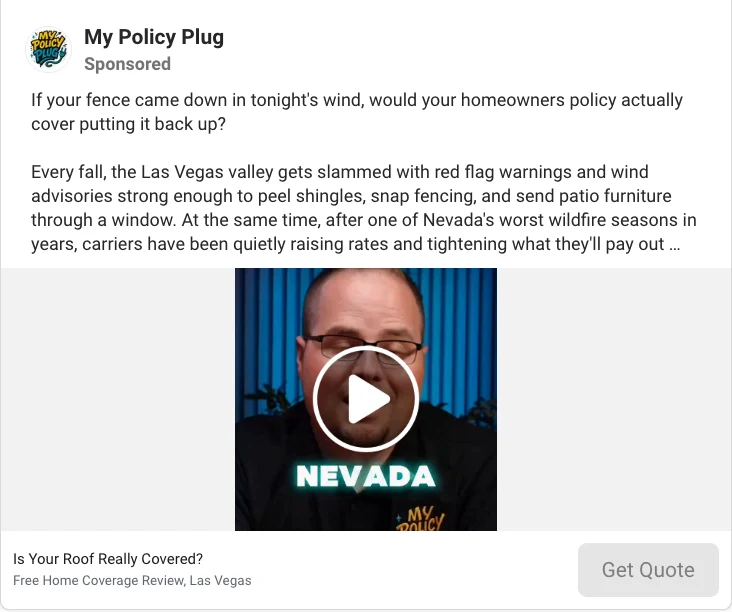
Notice what is missing from all five: price. Nobody leads with a number. They lead with free, fast, safe and covered.
Three roofing lead ads to copy
Meta gives you two instant form types. More volume is the default two-tap form: pre-filled fields, cheapest leads, more junk. Higher intent adds a review screen before the form is sent: fewer leads, fewer fakes. Use more volume after a storm, when you want every homeowner. Use higher intent for replacement ads, where one good lead is worth a lot.
Keep the questions short. One or two multiple-choice questions beyond name, phone and address is the sweet spot. Each extra question cuts volume and raises quality.
1. The free inspection ad
- Creative: a phone video of you or your crew lead on a real roof in the area. Not stock. Homeowners can tell.
- Primary text: “Free roof inspection in [town]. We check shingles, flashing and gutters, then send you photos and a written report. No pressure, no obligation.”
- Headline: “Book your free roof inspection”
- CTA button: Get Quote.
- Form questions: street address, “What do you need?” (leak / storm damage / replacement / not sure), phone.
2. The after-the-storm ad
- Creative: a close-up of hail-damaged shingles next to a clean one, or a short phone video of an inspector on a roof.
- Primary text: “Hail hit [area] on [day]. Damage is often invisible from the ground. We’ll check your roof for free and tell you straight if it’s worth a claim.”
- Headline: “Get your roof checked after the storm”
- CTA button: Book Now.
- Form questions: “Are you filing an insurance claim?” (yes / not sure / no), “Do you own the home?” (yes / no), phone.
3. The old roof ad
- Creative: a before and after of a replacement you did, same angle, same light.
- Primary text: “Is your roof 20 years old or more? Get a free inspection, find out how much life it has left, and get a written replacement quote.”
- Headline: “Free replacement quote”
- CTA button: Get Quote.
- Form questions: “Roughly how old is your roof?” (under 10 / 10 to 20 / 20+ / not sure), “When are you hoping to do the work?” (this month / 1 to 3 months / just pricing), phone.
The “Do you own the home?” question earns its place. Renters cannot sign a roofing contract. Filtering them in the form saves a wasted truck roll.
Win the first call
Here is the uncomfortable part. Your ad does not win the job. Your callback does.
The homeowner after a storm does not wait. They fill in your form, then a competitor’s, then one more. Whoever calls first gets to set the appointment. The others get voicemail.
Now look at how most roofing leads actually move. Leads sit in Leads Center until somebody checks. The office downloads a spreadsheet at the end of the day. Even big CRM tools are not instant: HubSpot’s own help docs say its Facebook lead sync can take up to two hours. Two hours after a hailstorm is a long time.
A worked example
Say you run a roofing company with four crews and one office manager. After a storm you spend $1,500 on lead ads over three days, and the ads bring in a few dozen inspection requests.
The old routine: the office manager downloads leads twice a day, at 9am and 4pm. A lead that comes in at 10am waits six hours. The estimators are on roofs and see nothing until the office calls them. By the time anyone rings, a good share of those homeowners have already booked someone else.
The new routine: the second a homeowner submits the form, the lead lands in three places. A text alert goes to the on-call estimator’s phone. The lead goes into the CRM with the campaign and the answer to “What do you need?” attached. The office gets an email copy. “Storm damage” leads get called while the homeowner is still standing in the driveway.
Same ads. Same budget. The only thing that changed is the gap between the form and the phone call.
What LeadsNotify does here
This delivery step is what LeadsNotify does. LeadsNotify picks up each Facebook or Instagram lead and sends it straight to your CRM, spreadsheet and inbox seconds after the form is submitted. Add a text, WhatsApp, Telegram or Slack alert for the people who need to call. Set it up in minutes. No code.
Before you run ads, test it. Test it from the notifier in LeadsNotify, then check Lead Delivery. Open the notifier (My Notifier > Edit), click TEST NOTIFIER, pick your form, click Send now.

Then open Lead Delivery to see every lead and exactly where it went.

Route each lead to the person who calls
A lead in a spreadsheet is a task for later. A lead on the estimator’s phone is a call now. Three routing patterns that suit roofing:
- Lead to SMS for urgent leads. Storm damage and leaks go to the on-call estimator as an instant text alert. Crews on roofs read texts. They do not read email.
- Lead to CRM for every lead. Every lead lands in your pipeline with address, source and campaign attached, so you know which ad booked which job. See how to connect Facebook campaign leads to your CRM.
- Lead to the team chat. If your crews run the day in WhatsApp or Telegram, send the lead to the group they already watch. Whoever is closest claims it. WhatsApp alerts are on paid plans; Telegram works on every plan, free included.

The roofing follow-up cadence
First contact is not the finish line. Replacement jobs especially take several touches. A cadence that fits roofing:
- Minute 0 to 5: call. If no answer, text. Reference the form. “Hi Dave, it’s Mike from [company]. You asked us to check your roof after Tuesday’s storm. I can be there tomorrow at 10 or 2. Which works?”
- Same day: second call at a different time if you did not connect.
- Day 1 after the inspection: send the photos and the written report. This is where trust is won.
- Day 3: follow up on the quote. Answer questions about the insurance claim if there is one.
- Week 2 onward: monthly check-in for replacement leads who are “just pricing”. Send a short note after the next storm in their area.
Two hygiene rules. Use the higher intent form type when junk leads creep up. Put homeowners who did not book into a retargeting audience. The homeowner who was “just pricing” in spring often signs after the first leak in autumn.
Measure five numbers
Track these weekly, and keep your own baseline. Roofing numbers swing hard with season and storms, so compare this week to the same conditions, not to an industry average.
| Metric | What to watch |
|---|---|
| Cost per lead | The trend over time, split by storm and non-storm weeks. |
| Speed to first call | Minutes, not hours. Measure from form submit to first dial. |
| First-attempt contact rate | Goes up when the call happens while the homeowner is still at home. |
| Inspection booked rate | Leads who agreed to an inspection. Your best early signal of ad quality. |
| Close rate on inspections | Inspections that turned into signed jobs. |
If cost per lead is fine but inspections are low, the leak is almost always between the form and the first call. Fix delivery and speed before you change the ads. The same is true in every local trade: our breakdown of Facebook ads for real estate finds the same gap.

Your ads are working. Make sure the leads are too. Connect your Facebook Page, pick your lead form, and choose where each lead goes. Set it up in minutes. No code.
FAQ
What is the best way to get roofing leads?
Run Facebook and Instagram lead ads with a free inspection offer, aimed at the areas you serve, and turn spend up after storms. Back it with referrals and yard signs from finished jobs. Ads give you volume you can control. Referrals give you the best close rate.
How fast should I call a roofing lead?
Within minutes. After a storm, homeowners contact several roofers at once and usually book whoever calls first. Send every lead straight to the on-call estimator’s phone so nobody waits for the office to check a dashboard.
Are bought roofing leads worth it?
Sometimes, if you can call them within minutes. Some vendors sell the same lead to several roofers, so you are paying to join a race. Leads from your own ads asked to hear from you, which usually makes the first call easier.
What questions should a roofing lead form ask?
Keep it short: address, what they need (leak, storm damage, replacement), and a phone number. Add “Do you own the home?” to filter renters, and “Are you filing an insurance claim?” if you run storm ads.
How can I see what roofing ads other roofers are running?
Search the free Meta Ads Library for “roof inspection” or “storm damage” and filter by your country. Every active ad on Facebook and Instagram is listed, with the date it started running.
Why are my Facebook roofing leads not getting answered?
Usually because they sit in Meta’s Leads Center, which sends no instant alert for each new lead and deletes lead data after 90 days. Connect a tool that sends each lead to your CRM and your phone the moment the form is submitted.
Last Updated on October 12, 2026 by Akash Mehra
Set up a free notification in a few minutes.