How to Connect Facebook Lead Ads to a Webhook
Below is the complete revised Gutenberg HTML. I’ve kept the existing image and product context, strengthened the **Facebook Lead Ads webhook / Facebook leads webhook** topic, and added practical sections without over-optimizing the unrelated GSC queries. When businesses generate leads through Facebook…

Table of contents
When businesses generate leads through Facebook Lead Ads, getting those leads into another system quickly is important. A Facebook Lead Ads webhook can automatically send new lead information to another application or URL as soon as a lead is submitted, instead of requiring someone to manually export and transfer the data.
In this guide, we’ll explain how Facebook lead webhooks work, what a webhook is, how it differs from an API, and how you can use LeadsNotify to send Facebook leads to a webhook URL with a simpler setup.
What Is a Webhook?
A webhook is a way for one system to automatically notify another system when a specific event happens. Instead of repeatedly asking whether new data is available, the receiving system gets the information when the event occurs.
For example, imagine you order an Americano at a restaurant. You could walk to the counter every minute and ask whether your coffee is ready. Or you could wait at your table and let the restaurant notify you when the coffee is ready.
- Polling: You repeatedly ask whether something has changed.
- Webhook: The system automatically sends you information when something changes.
That is the basic idea behind a webhook. When an event occurs in one system, that system sends information to another system, usually through an HTTP request.
How Do Webhooks Work?
A typical webhook workflow has three main parts: an event, a sender, and a destination URL.
- An event occurs in the source application.
- The source application sends an HTTP request containing the relevant data.
- The receiving application processes the information sent to its webhook URL.
For example, when someone submits a Facebook Lead Ads instant form, the new lead can trigger a lead-delivery workflow. The lead information can then be sent to a configured webhook URL for processing by your own application or another service.
Webhook vs. API: What’s the Difference?
Webhooks and APIs can both be used to exchange data between applications, but they work differently.
- API: Your application makes a request to retrieve or send information.
- Webhook: The source system sends information to your URL when a configured event occurs.
For lead generation workflows, webhooks can be useful when you want new leads delivered automatically rather than repeatedly checking another system for changes.
What Is a Facebook Lead Ads Webhook?
A Facebook Lead Ads webhook is a mechanism for receiving information about new leads generated through Facebook Lead Ads. When a prospect submits an instant form, the lead data can be delivered to a connected system so it can be processed automatically.
This is particularly useful for businesses running lead-generation campaigns at scale. Instead of downloading leads from Facebook and manually importing them into another application, an automated webhook workflow can move the information to the next step of your process.
How Facebook Lead Webhooks Work
A simple Facebook leads webhook workflow looks like this:
- A prospect sees your Facebook or Meta lead-generation advertisement.
- The prospect submits the instant form.
- The new lead becomes available to the connected lead-delivery workflow.
- The lead information is sent to the configured webhook URL.
- Your application or another connected service receives and processes the lead.
The exact data available depends on the lead form and the integration being used, but commonly includes information such as a name, email address, phone number, and other responses collected through the instant form.
Why Use a Facebook Lead Ads Webhook?
Manual lead exports can become difficult to manage when a campaign generates a large number of leads. A webhook-based workflow can help automate the transfer of new lead information.
- Faster lead delivery: New leads can be sent to your system without waiting for a manual export.
- Less manual work: Your team does not need to repeatedly download and transfer lead files.
- Automated workflows: Your application can trigger additional actions after receiving a lead.
- Better lead management: Leads can be routed to the tools your team already uses.
- Scalable lead processing: Automated delivery becomes more useful as campaign lead volume increases.
Setting Up a Facebook Lead Ads Webhook with LeadsNotify
If you need a simple way to send Facebook leads to a webhook URL, LeadsNotify provides a workflow that connects your Facebook Lead Ads forms with a destination URL.
Instead of building and maintaining the complete lead-delivery infrastructure yourself, you can configure the Facebook lead source and provide the URL where you want LeadsNotify to send the lead data.
Step 1: Connect Your Facebook Page
First, connect the Facebook page that contains the instant forms you want to use with LeadsNotify.
If you haven’t connected a Facebook page yet, follow our guide on how to connect and configure Facebook pages with LeadsNotify.
Step 2: Create a Webhook Notifier
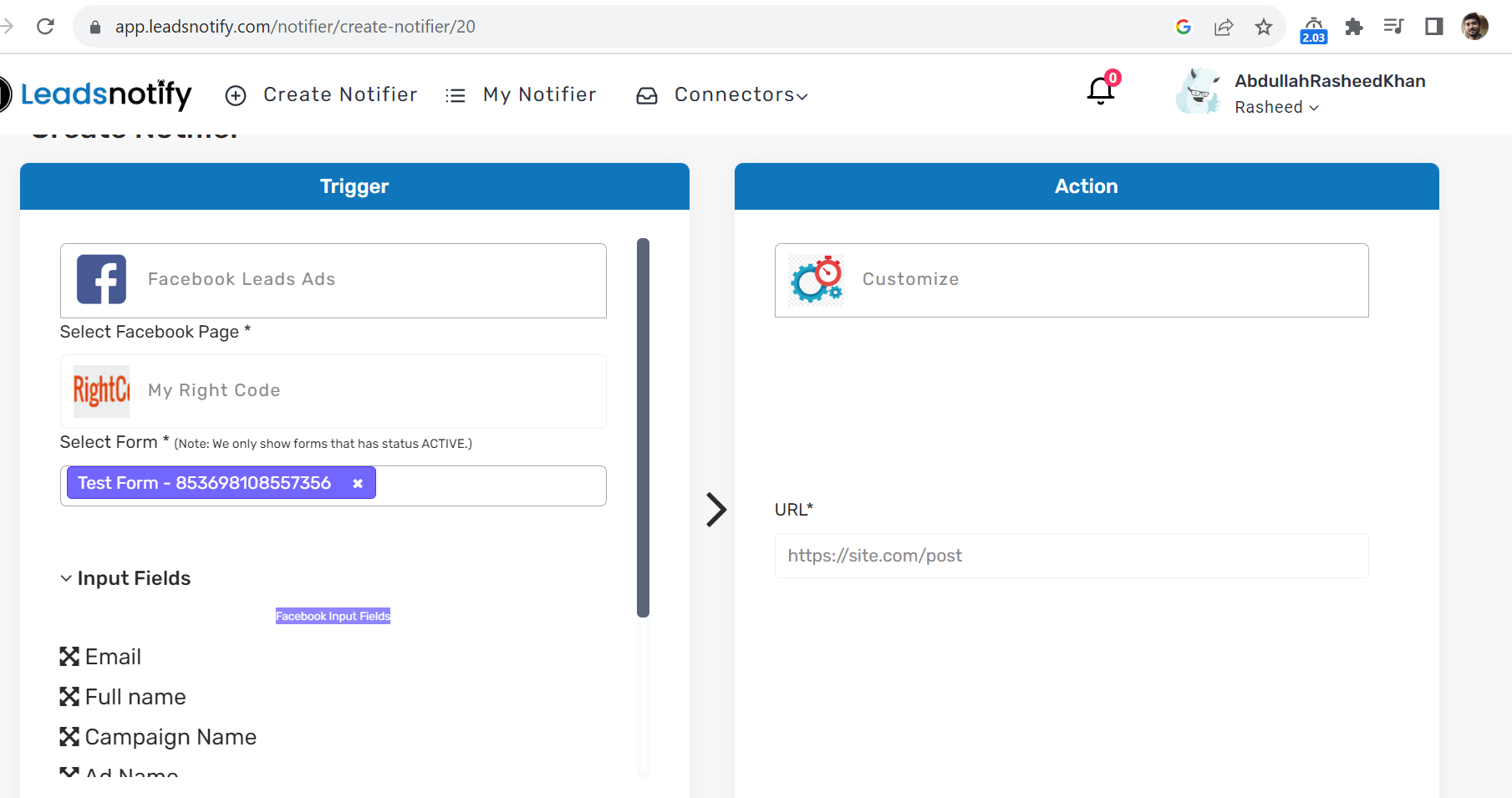
After connecting your Facebook page, log in to LeadsNotify and create a new notifier. Select the Facebook lead source and configure the webhook or POST destination for the workflow.
Step 3: Select Your Facebook Page and Instant Forms
In the trigger section, select the Facebook page you want to use and choose the instant forms that should trigger the workflow.
You can select multiple instant forms when configuring the Facebook lead source. LeadsNotify can retrieve the fields from the selected forms so they can be used when processing the lead data.
Step 4: Add Your Webhook URL
In the action section, enter the URL where you want to receive your Facebook leads. This can be an endpoint in your own application or a webhook URL provided by another service.
The endpoint should be prepared to receive the HTTP request and process the lead information sent by the integration.
Step 5: Test the Facebook Lead Webhook
Before using the workflow for live campaigns, send a test lead to verify that your webhook endpoint is receiving and processing the information correctly.
Testing allows you to check the complete flow, including the Facebook form, lead fields, webhook URL, request data, and your receiving application.
What Can You Connect to a Facebook Lead Webhook?
A webhook URL can be used as a bridge between Facebook Lead Ads and many different types of applications. Depending on your workflow, you can use the incoming lead data to update a database, trigger an internal process, notify your team, or send information to another platform.
- Google Sheets: Send or process Facebook lead data through a connected workflow.
- Excel-based workflows: Route lead data into an automation that eventually updates an Excel file.
- Email notifications: Trigger an email workflow whenever a new lead arrives.
- Mailchimp: Pass lead information into a marketing automation workflow.
- HighLevel: Send lead data into a connected CRM or marketing workflow.
- Airtable: Store incoming lead information in a database-style workflow.
- Custom applications: Send the lead to an endpoint built specifically for your business.
How to Test a Facebook Lead Ads Webhook
Testing is an important part of setting up any Facebook lead webhook. Before sending real advertising traffic through the workflow, confirm that the endpoint can receive and process the expected information.
- Confirm that the correct Facebook page is connected.
- Confirm that the correct instant form is selected.
- Verify that the webhook URL is correct.
- Send a test lead through the configured workflow.
- Check the receiving application or server for the incoming request.
- Verify that the lead fields were received and processed correctly.
Troubleshooting Facebook Lead Webhooks
If a Facebook lead is not reaching your webhook endpoint, check the following areas first.
- Facebook connection: Make sure the correct Facebook page is connected and authorized.
- Instant form: Verify that the correct lead form is selected in the notifier.
- Webhook URL: Check that the destination URL is correct and accessible.
- Server response: Make sure your endpoint can accept the HTTP request and handle the submitted data.
- Field mapping: Check that the lead fields expected by your application match the information being sent.
- Test delivery: Run another test lead and review your receiving application’s logs or delivery information.
Facebook Lead Ads Webhook Best Practices
- Test before launching: Always verify the complete workflow before sending live campaign traffic.
- Use a reliable endpoint: Your webhook URL should be available whenever new leads need to be processed.
- Validate incoming data: Your application should check and validate the information received from the webhook.
- Monitor failures: Keep an eye on failed requests so leads do not get lost without your team knowing.
- Protect your endpoint: Use appropriate authentication and security controls when exposing a webhook endpoint.
- Keep your workflow maintained: Review connected applications, permissions, endpoints, and integrations periodically.
Frequently Asked Questions
What is a Facebook Lead Ads webhook?
A Facebook Lead Ads webhook is a way to automatically deliver information about new Facebook leads to a connected application or URL. It can help businesses process new leads without manually exporting and transferring them.
How does a Facebook leads webhook work?
When a prospect submits a connected Facebook instant form, the lead information can be passed through a configured webhook workflow to a destination URL. The receiving application can then process the information and trigger additional actions.
Can I send Facebook leads to a webhook URL?
Yes. LeadsNotify allows you to configure a Facebook lead source and provide a destination URL for sending lead information. This can be useful when connecting Facebook Lead Ads with a custom application or another service that supports webhooks.
What is the difference between a Facebook webhook and an API?
An API generally requires your application to make a request when it wants to retrieve or send data. A webhook works in the opposite direction: the source system sends information to your endpoint when a configured event occurs.
Can Facebook Lead Ads webhooks send leads to Google Sheets?
Yes, a Facebook lead webhook can be part of a workflow that ultimately sends lead information to Google Sheets. The exact setup depends on the webhook receiver and automation service used to process the incoming lead.
Can I send Facebook leads to my own application?
Yes. If your application provides a suitable endpoint that can receive and process the incoming request, you can use a webhook workflow to send Facebook lead information to your own system.
Send Facebook Leads to a Webhook Automatically
Webhooks provide a practical way to move information between applications when an event occurs. For businesses using Facebook Lead Ads, a Facebook Lead Ads webhook can help automate the process of delivering new leads to another application, database, CRM, notification system, or custom endpoint.
Building and maintaining a complete Facebook lead webhook system yourself can require development work, permissions, monitoring, and ongoing maintenance. LeadsNotify provides a simpler alternative by allowing you to connect your Facebook page and instant forms and send the resulting lead data to a webhook URL.
If you’re looking for a simpler way to automate Facebook leads via webhook or POST request, try LeadsNotify and start building your lead-delivery workflow.
Set up a free notification in a few minutes.

Abdullah Khan
A Technical Lead and backend architect with 10+ years of experience building reliable, high-scale APIs and automation systems. At LeadsNotify, he helps build and maintain the integrations that route Facebook and LinkedIn leads to email, CRMs, and marketing tools in real time.
Connect on LinkedIn ↗