
How to Get Facebook Leads to Google Sheets
Want to get Facebook leads into Google Sheets automatically? Connecting Facebook Lead Ads to Google Sheets gives your team a simple way to collect, organize, and manage new leads without manually copying contact information. In this guide, we'll show you how to…

Table of contents
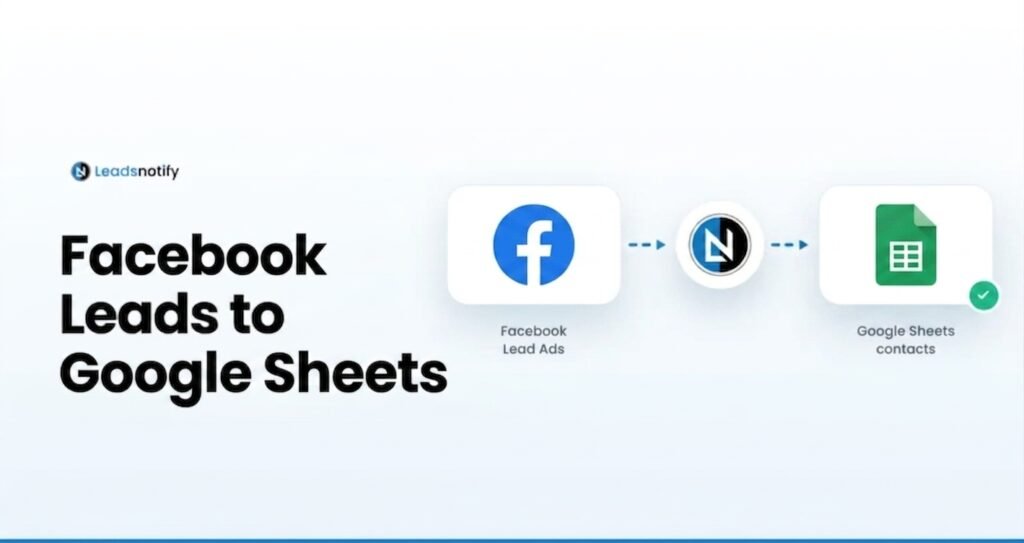
Want to get Facebook leads into Google Sheets automatically? Connecting Facebook Lead Ads to Google Sheets gives your team a simple way to collect, organize, and manage new leads without manually copying contact information.
In this guide, we’ll show you how to connect Facebook leads to Google Sheets using LeadsNotify. You’ll learn how to authorize your Facebook Page, connect your lead source, map lead fields to your spreadsheet, and test the integration.
This setup is especially useful for businesses that run Facebook Lead Ads and need a simple way to send new leads to a shared spreadsheet for follow-up, reporting, or further processing.
Why Send Facebook Leads to Google Sheets?
Facebook Lead Ads can generate new contacts quickly, but manually downloading or copying those leads into a spreadsheet can become time-consuming as your campaigns grow. Connecting Facebook Lead Ads to Google Sheets helps keep your lead data organized in one place.
- Centralize your leads: Keep new Facebook leads in a shared Google Sheet.
- Reduce manual data entry: Avoid repeatedly copying lead information from Facebook.
- Improve follow-up: Give your sales or customer support team faster access to new leads.
- Organize lead data: Use Google Sheets to sort, filter, and review incoming contacts.
- Collaborate with your team: Multiple team members can work with the same spreadsheet.
- Connect with other workflows: Use the spreadsheet as part of your broader sales or marketing process.
How the Facebook Leads to Google Sheets Integration Works
The basic workflow is simple. A person submits a Facebook Lead Ad form, LeadsNotify receives the lead, and the lead information is transferred to your selected Google Sheet.
- A prospect submits your Facebook Lead Ad form.
- LeadsNotify receives the new lead information.
- The integration matches the Facebook lead fields with your Google Sheet columns.
- The lead is added to your spreadsheet.
- Your team can review and follow up with the new contact.
This means you can connect Facebook Lead Ads to Google Sheets without relying on a manual export-and-import process for every batch of leads.
How to Connect Facebook Leads to Google Sheets
With LeadsNotify, you can create a connection between your Facebook Lead Ads and Google Sheets and automatically send new lead information to your spreadsheet.
Step 1: Prepare Your Facebook Lead Form
Before creating the integration, make sure you have a Facebook Page with a Lead Ad or instant form that collects the information you want to send to Google Sheets.
Your form might collect fields such as:
- First name
- Last name
- Email address
- Phone number
- Company name
- Custom questions
The fields available in your Google Sheet will depend on the information collected by your Facebook lead form.
Step 2: Connect Your Facebook Account to LeadsNotify
Log in to your LeadsNotify account and connect your Facebook account.
During the connection process, authorize the permissions required to access your Facebook Pages and lead forms. Select the Facebook Page that contains the Lead Ad you want to connect.
Make sure you select the correct Page and grant the required lead-access permissions. Without the appropriate permissions, the integration may not be able to receive new leads.
Step 3: Create a Google Sheets Notifier
After connecting Facebook, open the notifier or integration section in LeadsNotify and select Google Sheets as your destination.
Choose the Google account and spreadsheet where you want your Facebook leads to be added. If you manage leads for multiple campaigns, you can organize them in separate spreadsheets or worksheets based on your workflow.
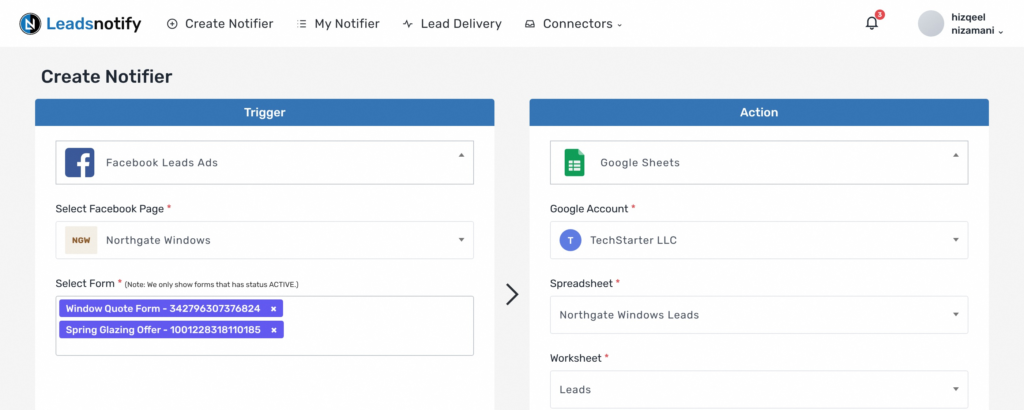
Step 4: Select Your Facebook Lead Form
Next, select the Facebook Page and Lead Ad form you want to connect to Google Sheets.
If you run multiple Facebook Lead Ads, make sure you select the correct form. The selected form determines which lead information will be available for the integration.
Step 5: Map Facebook Lead Fields to Google Sheets
Field mapping tells the integration where each piece of Facebook lead information should be placed in your Google Sheet.
For example, you might map your Facebook form fields like this:
| Facebook Lead Field | Google Sheets Column |
|---|---|
| First Name | First Name |
| Last Name | Last Name |
| Phone Number | Phone |
| Company Name | Company |
Make sure each important field is mapped to the correct column. Accurate field mapping helps keep your spreadsheet organized and makes it easier for your team to use the incoming lead data.
Step 6: Confirm the Integration
Review your Facebook Page, lead form, Google Sheet, and field mappings before saving the integration.
Once everything looks correct, save or submit the configuration. LeadsNotify can then process new leads from the connected Facebook form and send them to Google Sheets.
Step 7: Test the Facebook to Google Sheets Integration
Before sending significant traffic to your campaign, test the connection with a test lead.
- Submit a test lead through your Facebook Lead Ad form.
- Wait for LeadsNotify to process the lead.
- Open the connected Google Sheet.
- Check that the new lead appears in the expected row.
- Verify that the information is in the correct columns.
If the test lead appears correctly, your Facebook Lead Ads to Google Sheets integration is ready to use.
How to Connect Multiple Facebook Lead Forms to Google Sheets
Businesses often run multiple campaigns or lead forms at the same time. Instead of manually exporting each form, you can use an integration workflow to organize incoming leads in Google Sheets.
With LeadsNotify, you can connect multiple Facebook instant lead forms within your lead-management workflow. This can be useful when different campaigns collect leads for different products, services, locations, or audiences.
For example, you could organize your spreadsheet with separate worksheets or use additional columns to identify the campaign, form, or lead source.
Facebook Lead Ads to Google Sheets vs. Manual Export
| Feature | Manual Export | Automated Integration |
|---|---|---|
| Lead transfer | Manual | Automatic |
| Data entry | May require copying or importing | Reduced manual work |
| Lead availability | Depends on when you export | New leads can be sent automatically |
| Team access | Requires sharing exported files | Leads can be stored in a shared Google Sheet |
| Scalability | Becomes harder with more leads | Better suited to ongoing lead generation |
Manual exports can work for small campaigns, but an automated connection becomes more useful when your Facebook campaigns generate leads regularly.
Benefits of Using LeadsNotify to Send Facebook Leads to Google Sheets
LeadsNotify provides a straightforward way to connect Facebook lead generation with Google Sheets and other business tools.
- Automate lead delivery: Send new Facebook leads to your connected workflow instead of manually moving data.
- Reduce repetitive work: Spend less time downloading and copying lead information.
- Support multiple lead forms: Manage leads from different Facebook instant forms within your workflow.
- Keep lead information organized: Store incoming contacts in a structured Google Sheet.
- Improve response time: Give your team quicker access to new leads so they can follow up.
- Connect with other tools: Use LeadsNotify to route lead information to supported CRM, email, spreadsheet, and business applications.
Tips for Managing Facebook Leads in Google Sheets
Once your Facebook leads to Google Sheets integration is working, a few simple practices can make the spreadsheet easier to manage.
- Keep consistent column names: Use clear headings such as Name, Email, Phone, Campaign, and Lead Source.
- Separate campaign data: Use worksheets or columns to distinguish different campaigns and lead forms.
- Use filters: Filter leads by campaign, date, status, or assigned team member.
- Track follow-up status: Add a column such as New, Contacted, Qualified, or Converted.
- Protect important columns: Prevent accidental changes to columns that are populated automatically.
- Check new leads regularly: Make sure your sales or support team knows where incoming leads are stored.
Troubleshooting Facebook Leads Not Appearing in Google Sheets
If a Facebook lead does not appear in your Google Sheet, check the integration from the source to the destination.
- Check Facebook permissions: Make sure LeadsNotify has the required access to your Facebook Page and leads.
- Verify the selected Page: Confirm that the correct Facebook Page is connected.
- Check the lead form: Make sure the integration is connected to the correct instant form.
- Review field mapping: Confirm that Facebook fields are mapped to the correct Google Sheets columns.
- Check the Google Sheet: Make sure you selected the correct spreadsheet and worksheet.
- Submit another test lead: A new test can help determine whether the issue is with the form or the integration.
- Check delivery information: Review the integration or delivery status in LeadsNotify if the lead still does not appear.
Frequently Asked Questions
How do I connect Facebook leads to Google Sheets?
You can connect Facebook leads to Google Sheets by using an integration service such as LeadsNotify. Connect your Facebook Page, select the relevant Lead Ad form, choose Google Sheets as the destination, map your lead fields, and test the connection.
Can Facebook Lead Ads send leads directly to Google Sheets?
Yes. An integration tool can receive leads from Facebook Lead Ads and send the lead information to a connected Google Sheet. This removes the need to manually copy every new lead into your spreadsheet.
Can I connect multiple Facebook Lead Ads to Google Sheets?
Yes. You can organize leads from multiple Facebook instant forms in your Google Sheets workflow. LeadsNotify supports workflows that can handle multiple Facebook lead forms, making it easier to manage leads from different campaigns.
How can I get Facebook leads into Google Sheets automatically?
Set up a Facebook Lead Ads integration with Google Sheets through LeadsNotify. Once the Facebook Page, lead form, destination spreadsheet, and field mapping are configured, new leads can be transferred automatically to the connected sheet.
Can I connect Meta leads to Google Sheets?
Yes. Facebook is part of Meta, so Facebook Lead Ads are also commonly referred to as Meta leads. You can use an integration workflow to send supported Meta or Facebook lead form data to Google Sheets.
What should I do if Facebook leads are not showing in Google Sheets?
Check your Facebook Page permissions, selected lead form, Google Sheet destination, field mapping, and integration status. You should also submit a test lead to determine whether the issue occurs when Facebook sends the lead or when the integration delivers it to Google Sheets.
Automate Facebook Leads to Google Sheets
Moving Facebook leads into a spreadsheet manually can become inefficient when your campaigns generate leads every day. Connecting Facebook Lead Ads to Google Sheets gives your team a simple way to centralize new contacts, organize lead information, and start follow-up sooner.
With LeadsNotify, you can connect your Facebook lead source, select the appropriate form, map your fields, and send new leads into your Google Sheets workflow.
If you’re looking for a simple way to connect Facebook leads to Google Sheets and reduce repetitive lead-management work, try LeadsNotify and automate your lead delivery.
Ready to automate your Facebook leads? Sign up for LeadsNotify and connect your Facebook Lead Ads to Google Sheets.
Last Updated on September 10, 2026 by Akash Mehra
Set up a free notification in a few minutes.

Abdullah Khan
A Technical Lead and backend architect with 10+ years of experience building reliable, high-scale APIs and automation systems. At LeadsNotify, he helps build and maintain the integrations that route Facebook and LinkedIn leads to email, CRMs, and marketing tools in real time.
Connect on LinkedIn ↗